
Coastal Shield Wash
Decontamination & sealant
For residue that is stuck but has not etched yet. Includes bug removal, a foam pre-soak, clay bar treatment, paint decontamination and a 6 to 8 month paint sealant.
Starting at
$120
See wash packagesGuide · Updated October 2026
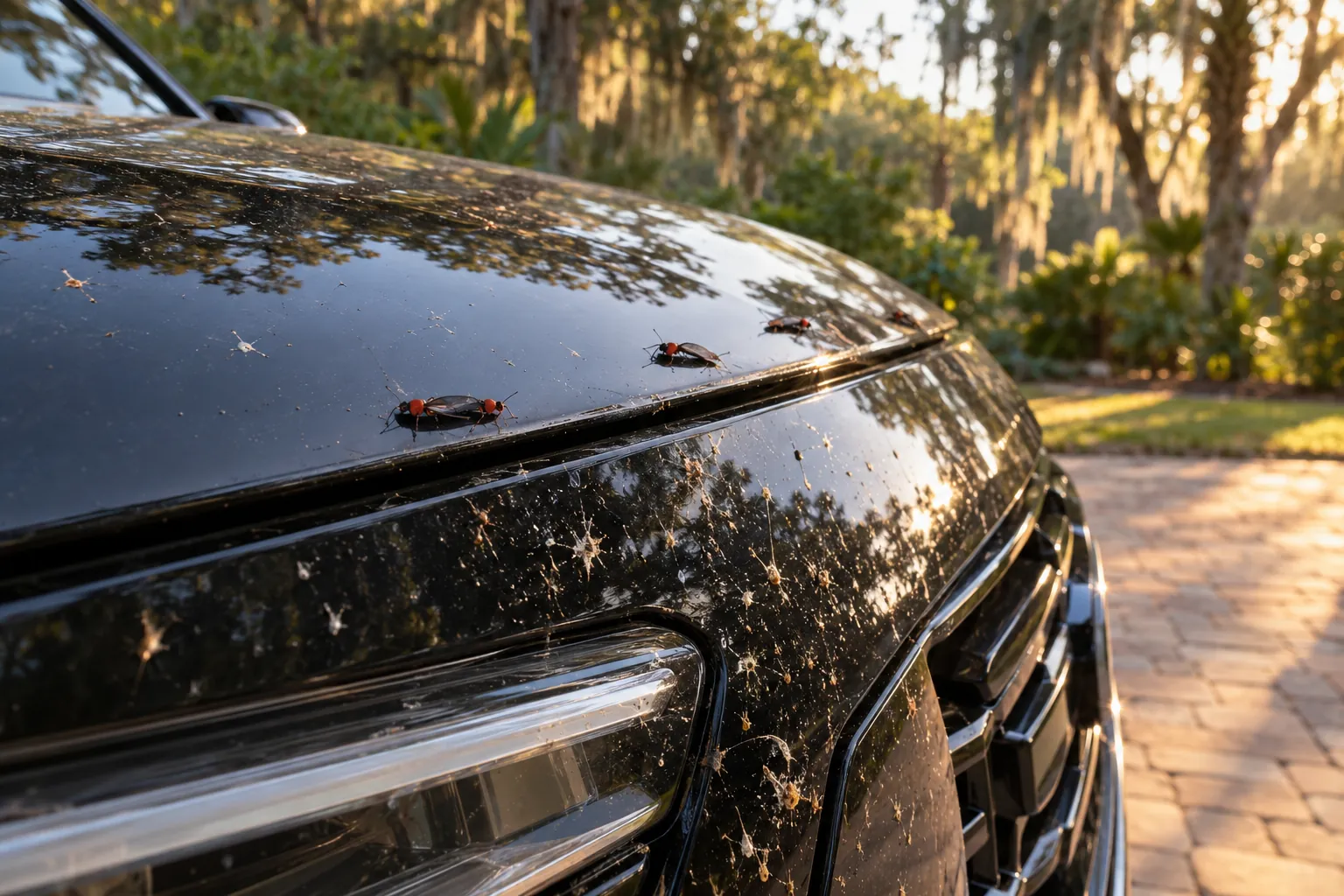
Lovebug season in Florida comes twice a year, and Jacksonville gets both flights. Here is when they hit, why the splatter on your bumper can etch the paint within a day or two, and how to get it off without scratching anything. The science comes from University of Florida entomologists. The cleanup advice comes from detailing cars across Jacksonville.
Lovebug season in Florida
Spring flight April to May
Late-summer flight August to September
April to May and August to September
each generation lasts about four weeks
fresh splatter starts near neutral, pH 6.5, then turns acidic
flights start around this air temperature
The paint problem
A fresh lovebug splatter is close to neutral, about pH 6.5. UF/IFAS researchers found it turns acidic, about pH 4.25, within 24 hours. Florida sun speeds that up by baking the residue onto the panel.
The good news from the same research: cleaned off before the sun bakes it for a day or two, it leaves no permanent damage. Left longer, it can etch the clear coat and leave dull, rough spots on the hood, bumper and mirrors.
Paint is not the only casualty. Big swarms can clog a radiator and make a liquid-cooled engine run hot, and a smeared windshield cuts your visibility.
The highway problem
It is not bad luck. Female lovebugs are attracted to exhaust fumes that have been exposed to sunlight, and heat attracts them too. A busy highway on a warm, sunny day has plenty of both, so drives on I-95, I-295 and I-10 during a flight end with a coated front end.
They only fly in daylight, once the air reaches about 68°F, and they do not fly at night. Adults live about three to four days, but new ones keep emerging for the whole four-week flight.
Protect your paint
UF/IFAS recommends coating the front of the car with wax. Any slick layer (wax, sealant or a ceramic coating) keeps the residue from bonding to the paint and makes it wash off easier.
Fresh splatter is close to neutral. Left in the Florida sun, it turns acidic within a day, and that is when it starts to etch the clear coat.
Let warm soapy water or a bug remover sit on the splatter for a few minutes so it softens. Dragging dried bugs across the paint with pressure scratches the clear coat.
Scouring pads, stiff brushes and dry paper towels all leave fine scratches. Use a soft microfiber or a dedicated bug sponge on wet, softened residue.
Large swarms can clog a radiator and make a liquid-cooled engine run hot. Rinse the grille and the front of the radiator after a heavy drive.
Lovebugs fly in daylight and do not fly at night. Long highway drives early or after dark mean far fewer hits.
Already baked on?
Coastal Shield Wash
For residue that is stuck but has not etched yet. Includes bug removal, a foam pre-soak, clay bar treatment, paint decontamination and a 6 to 8 month paint sealant.
Starting at
$120
See wash packagesGolden Hour Enhancement
For dull, etched spots left behind once the residue is gone. Machine polishing levels light etching in the clear coat, and every level includes protection.
Starting at
$500
About paint correctionQuestions
Lovebugs fly twice a year across Florida: once in April and May, and again in August and September. Each flight lasts about four weeks. The exact weeks shift with the weather from year to year.
They can. UF/IFAS found that splattered lovebugs are about neutral at pH 6.5 but turn acidic, pH 4.25, within 24 hours. Cleaned off before the sun bakes them for a day or two, they leave no permanent damage. Left longer, they can etch the clear coat.
Female lovebugs are attracted to sunlight-exposed exhaust fumes, and heat attracts them too. Busy, sunny highways give them both, which is why windshields and bumpers take the most hits on long drives.
Adult lovebugs live about three to four days. The swarms seem endless because new adults keep emerging for the roughly four weeks that each flight lasts.
Soften them first with warm soapy water or a bug remover, wait a few minutes, then wipe gently with a soft microfiber. Do it within a day. If the residue has already dulled the paint, a decontamination wash or polishing may be needed.
Usually. Light etching sits in the clear coat and machine polishing can level it out. Deeper damage is assessed in person. Our paint correction starts at $500 with protection included.
Feel free to link to or share this guide.
Jacksonville · Clay County · St. Johns County
Mobile detailing across Jacksonville, Clay County and St. Johns County. We bring our own water and power.